
All our Funds delivered positive returns last month. Fund reports are available below.
Effective from July 2026, we increased the regular distributions from the Affluence Investment Fund, Affluence LIC Fund and Affluence Small Company Fund. The higher distributions reflect yields of around 6% per annum based on the current unit prices. The first payment at the higher rate for the Affluence Investment Fund was 10 August. The other funds pay quarterly, with the first payments at the higher rate due to be paid approximately 10 October.
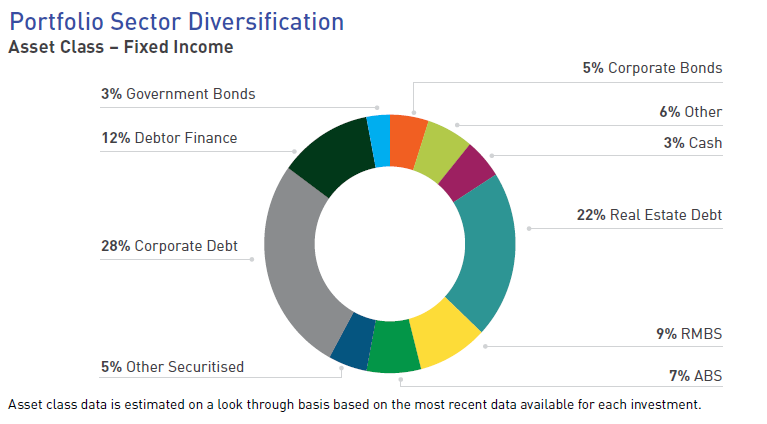
The Affluence Income Trust celebrated its three year anniversary in July. We’re very pleased with the results so far. Returns have averaged 7.5% per annum, exceeding our target of the RBA Cash Rate + 3% per annum, and the Fund has paid a distribution every month. The current distribution rate is 7.35% per annum.
In other news this month, we look at the fixed income dilemma, explain why petrol and diesel use could fall dramatically in Australia, take a look at who is making money from the AI boom and explain why cheques are on the way out.
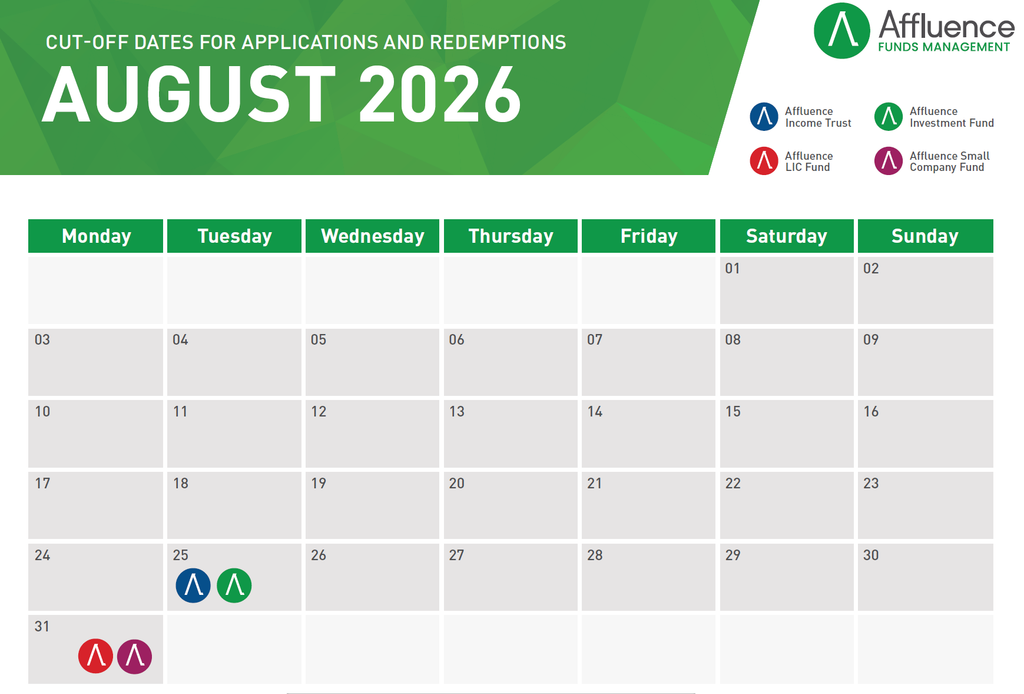
Should you wish to invest in any of our funds this month, head to the Invest Now page on our website to apply online or download paper forms. See below for the calendar of cut-off dates for this month. Applications received by the cut-off dates will be effective from 1 September.
As always, thanks for reading. If you have any questions or feedback, reply to this email or give us a call.
Regards,
Daryl, Greg and the Affluence Team.
Affluence Funds Returns
Affluence Investment Fund
Our flagship Fund is highly diversified and can invest across all asset classes. The portfolio includes an allocation to each of our other funds, plus over 20 different underlying managers and other investments selected by Affluence. The strategy seeks a balance between maximising returns, delivering monthly income and lowering volatility.
Affluence Income Trust
This Fund provides access to a highly diversified fixed income portfolio, targeting monthly distributions and preservation of capital over rolling 3 year periods.
The Fund has a flexible investment mandate, allowing us to take advantage of what we believe to be the best risk adjusted investment opportunities in the fixed income sector at any given time. The current distribution rate is 7.35% per annum.
Affluence LIC Fund
This Fund provides access to a specialised strategy that invests in a diversified portfolio of 20 to 35 ASX Listed Investment Companies (LICs) and other discount capture opportunities.
The Fund aims to deliver quarterly distributions of at least 5% per annum, and to outperform the ASX 200 Accumulation Index over time.
Affluence Small Company Fund
The Fund provides access to ASX Small Companies via a portfolio comprising direct investments, plus selected holdings in smaller LICs and unlisted funds focused on smaller companies.
The Fund is available only to Eligible Investors and aims to deliver quarterly distributions of at least 5% per annum, and to outperform the ASX Small Ordinaries Accumulation Index over time.
The Fixed Income Dilemma
Most fixed income investors are trying to balance three objectives.
They would like to maximise returns and liquidity, while minimising volatility. The problem is that these three objectives compete with each other. In this article we take a look at why you can usually only maximise two of the three objectives, and how the trade-off works.
Application and Withdrawals
To make a new investment, add to your existing investment or arrange a withdrawal from any of our Funds, head to our Invest page. There you can apply online or download paper forms.
Cut-off dates for August 2026 Applications and Withdrawals this month are shown below.
Fund In Focus
Affluence Income Trust
Are you looking for an investment option that targets decent, regular income, but without the risk associated with stock markets? Our Affluence Income Trust might be worth a look.
The Fund aims to provide you with:
- A minimum distribution equal to the RBA Cash Rate plus 3% per annum, paid monthly.
- Preservation of capital over rolling 3 year periods after payment of distributions.
- Access to a highly diversified portfolio of fixed income assets, with a focus on maximising returns with low volatility.
The current distribution rate is 7.35% per annum. Returns since inception have averaged 7.5% per annum*.
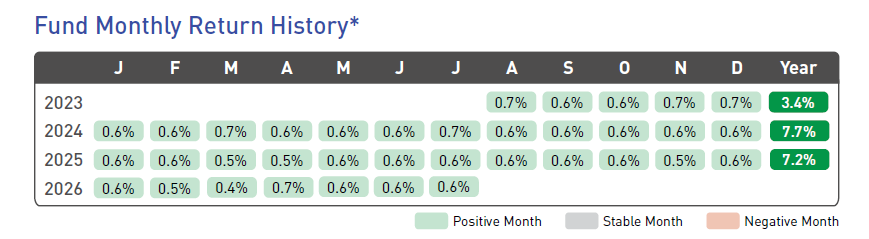
The Affluence Income Trust invests in a highly diversified fixed income portfolio, with a focus on maximising returns with low volatility. The Fund has a flexible investment mandate. This allows us to take advantage of what we believe to be the best risk adjusted investment opportunities within the fixed income asset class at any given time.
We aim for the portfolio to be diversified within the fixed income asset class by sub-sector, underlying manager, investment strategy, credit risk, liquidity, and investment structure.
The Fund is designed for use as up to a Core Component of an investment portfolio for those investors seeking Income and Capital Preservation with a one year or longer investment timeframe, a Low risk/return profile and needing access to capital Monthly or less often.
You can learn more about the Fund from the Fund Page on our website which you can access by clicking below.
Let us know if you would like us to call you to discuss the Fund in more detail.
Things we found interesting
Chart of the month
We really are using less fuel these days. This chart, courtesy of Antipodean Macro, shows a steady decline in automotive fuel use since 2013, with significant falls around COVID lockdowns, and earlier this year.
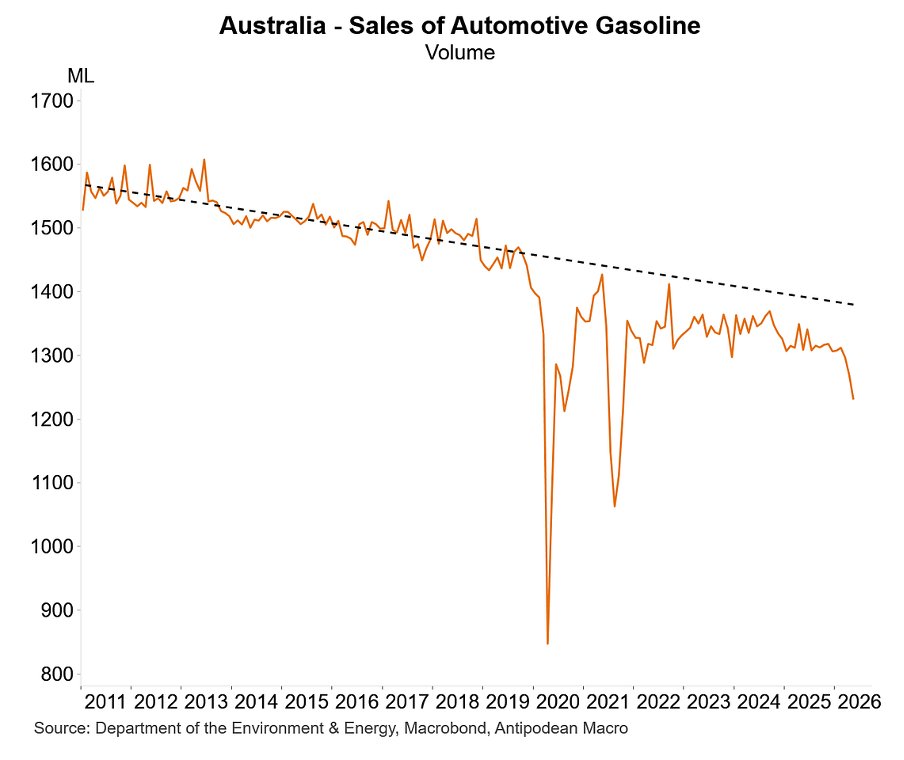
So far, electric vehicles have only played a modest role in this decline. The Australian vehicle fleet turns over slowly, and EVs still represent only around 3% of cars on Australian roads. Improved fuel efficiency, hybrid vehicles and changing driving patterns have also contributed.
However, the next decade could look very different.
EV adoption is now accelerating rapidly. Battery electric and plug in hybrid vehicles represented over 25% of Australian light vehicle sales during the first half of 2026, compared with just 13% during 2025. In July, they represented more than 30% of new vehicle sales. As those vehicles progressively replace petrol powered cars, the reduction in fuel consumption could accelerate.
There could also be another important catalyst, vehicle to home (V2H) technology. Many EVs have 50–85kWh of battery storage, versus perhaps 10–30kWh for a typical home battery system. Once bidirectional charging becomes widely available, an EV parked in the garage could become part of the household energy system.
For a home with rooftop solar, the proposition becomes particularly attractive. Cheap solar electricity can charge both the household battery and the car. The EV can then help power the house overnight, provide backup power during outages and potentially even sell electricity back to the grid when prices are high.
At that point, an EV is a large mobile battery that just happens to come with a car attached. That could make the downward slope in Australian petrol consumption considerably steeper, although equipment availability, standards and connection rules remain barriers.
Chart of the Month 2
One of the more interesting features of the artificial intelligence boom is that the companies closest to the end customer are currently the least profitable. This chart, produced by Apollo Global Management Chief Economist Torsten Slok, shows who is making money across four parts of the AI value chain. The contrast is striking.
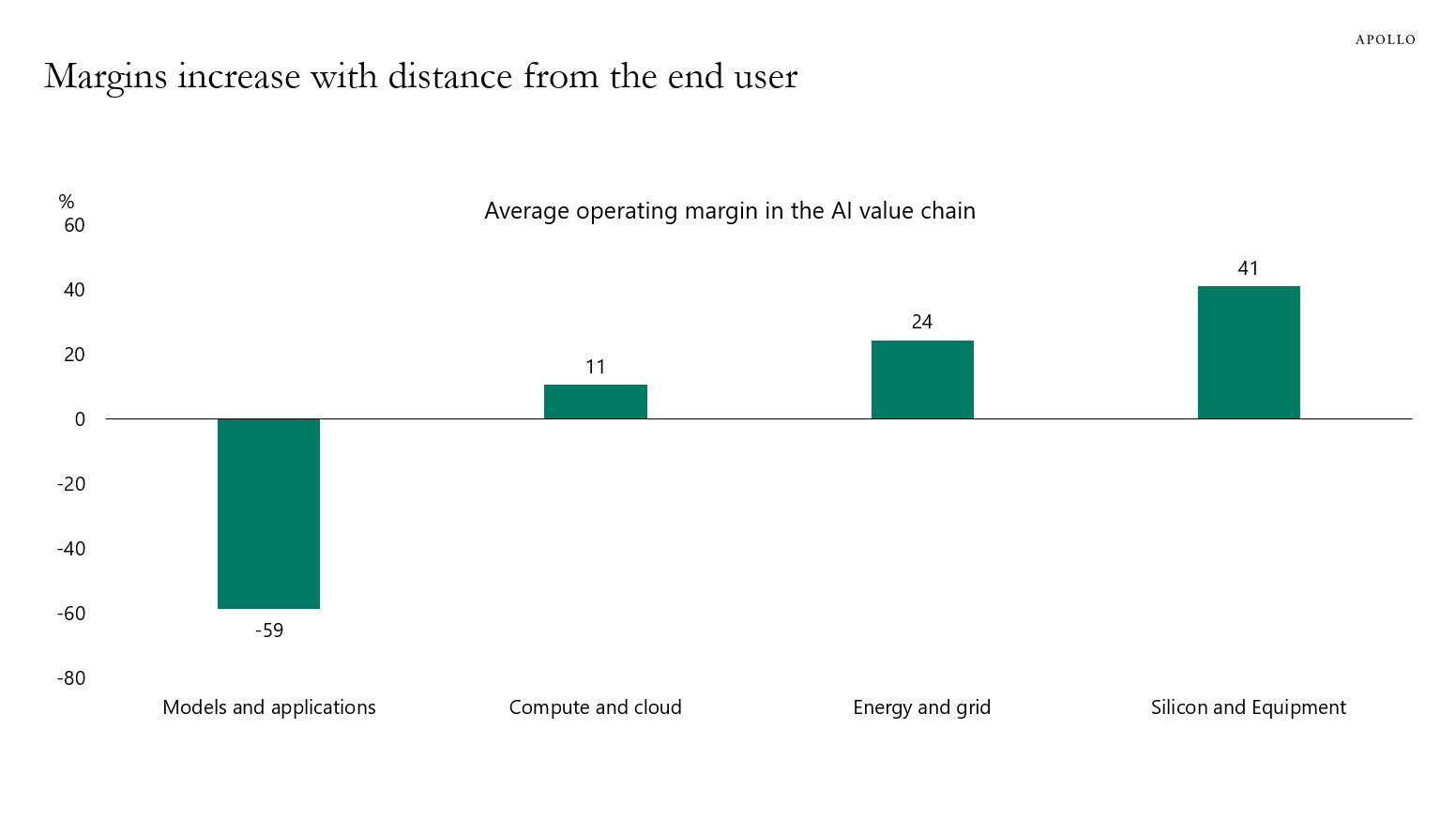
Silicon and equipment companies such as Nvidia are enjoying average operating margins of around 41%. Energy and grid companies are earning about 24%, while compute and cloud providers including Amazon, Microsoft and Google average around 11% margins.
At the other end of the chain, the model and application companies closest to the ultimate users, mostly Open AI (ChatGPT) and Anthropic (Claude) are collectively operating at huge negative margins, more commonly known as losses. As Slok points out, this is the reverse of what we expect. Usually, the business owning the customer relationship captures the greatest economic value. In AI, at least for now, the greatest profits are being earned further upstream.
That goes to the heart of the sustainability of the AI investment boom. The enormous profits being earned depend on continued spending by companies further down the chain. In Slok’s words, the 41% profit margin effectively depends on the negative 59% remaining financeable.
That does not necessarily mean that AI is a bubble. Loss making businesses can become profitable as revenues scale. The economics of AI could improve dramatically as computing costs fall and adoption increases. But eventually the AI model builders need a return on capital and the end user must be prepared to pay the real costs of the service. Otherwise, spending on chips, data centres, electricity and related infrastructure will eventually slow. And that would be a problem for most financial markets.
Do you still use cheques?
Cheques are on the way out in Australia. The Federal Government has adopted a national timetable that will mean no more cheques can be issued after 30 June 2028. Banks may continue letting you deposit existing cheques until 30 September 2029, but that’s it. This applies to all types, including personal, business and bank cheques.
The change has been prompted by very low usage. In 2023, fewer than one cheque per person was written in Australia, compared with around 50 per person in the mid 1990s. Electronic transfers, BPAY, cards and services such as PayID have largely replaced them.
Individual banks do not have to wait until the national deadlines, and several are already moving much faster. Bank of Queensland, for example, stopped issuing bank cheques in June 2026 and will stop honouring its customers’ personal and business cheques from 30 September this year. ANZ, CBA and Westpac have progressively restricted access to cheque books and bank cheques over time. Some smaller banks have already withdrawn cheque services altogether. So if you regularly use them, it’s worth checking with your bank rather than assuming they will remain available until the deadline.
Vaguely interesting facts.
Astound your friends with these morsels of knowledge:
- Red blood cells can travel around your entire circulatory system in about a minute.
- Woolly mammoths were still alive hundreds of years after the Pyramids were built.
- Squirrels accidentally plant trees sometimes, by forgetting where they bury nuts.
- Peppers, pumpkins, zucchini, eggplants and cucumbers are technically fruits.
- Video game hero Super Mario was named after Nintendo’s real life landlord. *
* Super Mario wasn’t originally called Mario. When he appeared in the 1981 arcade game Donkey Kong, Nintendo called him Jumpman. The character was later renamed after Mario Segale, the landlord for Nintendo’s US premises near Seattle.
Segale was an Italian-American property developer who apparently wasn’t especially interested in becoming a gaming celebrity. Nintendo of America was behind on its rent and had an awkward encounter with Segale around the time staff were looking for a better name for Jumpman. The precise details of that encounter have become somewhat embellished over the years, but Nintendo has confirmed the naming story is true.
Thanks for reading. If you enjoyed this newsletter, forward it to a friend. If you are that friend, you can subscribe below.
Let Us Help You Make Better Investment Decisions
Our monthly eNews includes Fund updates, investments ideas and other things we find interesting.
It’s the best way for us to keep in touch, and for you to get to know us better. And we believe it’s important that you understand how we invest before you consider putting your money to work with us. Subscribe here to get our best ideas delivered straight to your inbox.