
Understanding The Fixed Income Dilemma
Fixed income is often described as the defensive part of an investment portfolio. For many investors, it is expected to provide regular income, reduce reliance on share market returns and help smooth the overall investment journey. That description is broadly right. But it can also create an unrealistic expectation that fixed income investing is simple, safe and always stable.
The three things Investors want
Most fixed income investors are trying to balance three objectives.
The first is return.
This might come through interest payments, distributions or capital gains from changes in bond prices or credit spreads. In a higher rate environment, the potential return from fixed income can be materially better than it was during the ultra-low interest rate period post covid.
The second is liquidity.
Liquidity refers to how quickly an investor can access their capital and how reliably the investment can be sold or redeemed at a fair price. Cash and term deposits are usually highly liquid or have a known maturity date. Listed bond funds may be traded daily. Some private credit, direct lending or real estate debt investments may only offer monthly, quarterly or even less frequent access.
The third is volatility.
Volatility is the extent to which the value of an investment moves around over time. Some fixed income assets have very stable values. Others can move significantly, particularly when interest rates change, credit markets reprice or investors become more cautious.
The problem is that these three objectives compete with each other.
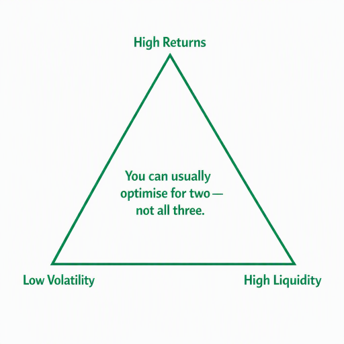
Why you can usually only have two.
If an investor wants high liquidity and low volatility, the obvious examples are cash, short-term deposits and very short duration, high quality fixed income. These investments can be very useful. They provide flexibility and stability. The trade-off is that returns are usually lower than more complex or less liquid alternatives.
If an investor wants higher returns and high liquidity, they may look to listed hybrids, high yield bonds, liquid credit funds or bond exchange traded funds. These investments can offer better return potential and usually allow reasonably quick access to capital. The trade-off is that market pricing can move around. In periods of stress, the value of these investments may fall, sometimes at exactly the time investors most want stability.
If an investor wants higher returns and lower volatility, the answer is often found in less liquid parts of the market. Private credit, direct lending, real estate debt and some securitised credit investments may offer attractive income and relatively stable valuations. The trade-off is that investors may need to accept less frequent withdrawals, longer notice periods, or the possibility that liquidity could be delayed in difficult market conditions.
This is the central fixed income bargain. Investors can target higher returns, better liquidity or lower volatility, but should be realistic about which two they are prioritising.
How the trade-off applies across fixed income assets
Cash is the simplest example. It provides high liquidity and very low volatility. It is ideal for short-term needs, emergency reserves and capital that may be required soon. But cash is unlikely to be the best long-term return option, particularly after inflation and tax.
Term deposits may offer slightly better returns than cash, with low visible volatility. However, investors often give up some flexibility, especially if capital is locked away for a fixed period or early withdrawal comes with a penalty. The return is known, but so is the limitation.
Government bonds are generally high quality and can be liquid, particularly in major markets. But they can still be volatile, particularly for longer term fixed rate bonds. When interest rates rise, the price of existing bonds can fall. This surprised many investors during recent years, when assets traditionally viewed as defensive produced negative returns for periods of time.
Investment grade corporate bonds add credit exposure. They can offer higher yields than government bonds. But they are exposed to both interest rate risk and credit spread risk, which increases volatility. Liquidity is usually reasonable, but not guaranteed during market stress.
High yield bonds and hybrids may provide even higher income. They are often accessible through listed markets or managed funds, which helps liquidity. But their prices can behave more like risk assets (stock markets) when economic conditions deteriorate. The investor gets higher return potential and liquidity, but must accept more volatility and credit risk.
Private credit and real estate debt can offer attractive income, particularly where lenders are being paid for complexity, illiquidity or specialist origination. These investments may have lower visible volatility than listed credit, partly because they are not traded every day. But investors must be comfortable with lower liquidity and the importance of careful manager selection, credit assessment and diversification.
Diversified income funds can sit between these categories. A well-managed income fund can combine cash, public credit, private credit, securitised assets and other fixed income opportunities. The objective is not to maximise any single feature, but to build a portfolio that balances return, liquidity and volatility in a sensible way.
The highest return is not always the best answer
One of the biggest mistakes in fixed income is simply chasing the highest yield. A high yield can be attractive, but it is also a signal. It may reflect higher credit risk, weaker security, more leverage, lower liquidity, complexity or a less favourable position in the capital structure.
That does not automatically make it bad. Some higher yielding opportunities are excellent. But the return should be considered alongside the risks being taken to achieve it.
For most investors, the better question is not “what has the highest return?” The better question is: “what is the best balance of return, liquidity and volatility for the role this investment is meant to play in my portfolio?”
For capital needed in the next few months, cash or short-term deposits may be the right answer, even if the return is lower. For long-term capital where some variation in value is acceptable, more liquid credit funds may make sense. For investors seeking higher income and who do not need daily access, less liquid credit strategies may be appropriate.
The right answer depends on purpose.
Where the Affluence Income Trust fits
The Affluence Income Trust has been designed to provide investors with a practical compromise across these three competing objectives.
It is a highly diversified portfolio of fixed income assets, with exposure across different subsectors, managers, underlying securities, geographies, credit risks and liquidity profiles. The Affluence Income Trust targets an income return of at least the RBA Cash Rate plus 3% per annum, while seeking to preserve capital over rolling three-year periods. It pays monthly distributions, with monthly applications and withdrawals.
That combination is important.
The Affluence Income Trust is not trying to be cash. It is not designed for investors who require daily access to every dollar at all times. Nor is it trying to maximise yield at any cost. Instead, it aims to provide a balanced fixed income solution: a higher income objective than cash, a diversified approach to managing risk, and a level of liquidity that may suit investors who can plan around monthly access.
In our view, that is often the right way to think about fixed income. The aim is not to win on one measure while ignoring the others. The aim is to build a sensible compromise.
Key Takeaways for Fixed Income Investors
Fixed income investing is full of trade-offs. Higher returns, high liquidity and low volatility are all desirable. But investors should be wary of any investment that appears to offer all three without compromise.
Cash offers liquidity and stability, but usually lower returns. Listed credit may offer liquidity and higher return potential, but with more volatility. Private credit and other less liquid strategies may offer attractive income and lower day-to-day volatility, but usually require investors to accept less immediate access to capital.
For many investors, the best answer is not the highest return available. It is the most appropriate balance between return, liquidity and volatility.
That is where a diversified income strategy can play a valuable role. The Affluence Income Trust aims to bring together a range of fixed income opportunities in a way that seeks to balance these competing objectives. For investors looking beyond cash and term deposits, but still wanting an income-focused investment with a disciplined approach to risk, it may represent an excellent compromise.
If you found this article helpful, here are some other things you might like.
Fixed Income Guide – Affluence Funds Management
Looking for an Alternative to Hybrids? We’ve already built one. – Affluence Funds Management
What is Volatility and Why Does it Matter – Affluence Funds Management
Disclaimer
This article is prepared by Affluence Funds Management Limited ABN 68 604 406 297 AFS licence no. 475940 for general information only and does not constitute investment advice. The content has been prepared without taking into account your objectives, financial situation or needs. In deciding whether to acquire or continue to hold an investment in any Affluence fund, you should consider the relevant Product Disclosure Statement or other disclosure document or continuous disclosure updates and the target market determinations available from Affluence.
Affluence, its subsidiaries, associates or any of their respective officers, employees, agents or advisers do not guarantee the performance or success of any Fund, the repayment of capital, or any particular rate of capital or distribution return. Past performance is not indicative of future performance. There are risks associated with an investment in the funds. Affluence recommends you consult your professional adviser to determine whether the products offered by Affluence fit your objectives, financial situation or needs before deciding to invest. Some Affluence funds are only available to eligible investors.