

March was a tough month in financial markets.
Our Funds weren’t immune to the oil shock, though 1 year returns remain good. Results were:
- +0.4% for the Affluence Income Trust (+6.9% over 1 year).
- -4.8% for the Affluence Investment Fund (+9.6% over 1 year).
- -6.9% for the Affluence LIC Fund (+8.7% over 1 year).
- -7.5% for the Affluence Small Company Fund (+14.3% over 1 year).
More details are in our monthly fund reports, which you can access below.
War in the Middle East dominated markets in March. Oil spiked more than 60% higher and both equity and bond markets decreased. The ASX200 Index fell 7%, the ASX Small Ords fell 11%, the S&P Developed Index fell 7% and the S&P500 fell 5%. Bond prices fell as interest rate expectations increased due to fears over rising inflation.
As we write this, things have settled down a bit, and markets have partly recovered March’s losses.
The RBA raised rates in March for the second month in a row. With the cash rate now at 4.1%, the distribution for the Affluence Income Trust has been increased again to 7.1% per annum, for the March distribution that was paid in April.
In other news, we’ve recently put the finishing touches on our fourth investment Guide, Surviving a Market Downturn. You can read more about it and download a copy below.
As always, thanks for reading and for your continued interest in what we do. If you have any questions or feedback, reply to this email or give us a call.
Regards, Daryl, Greg and the Affluence Team.
Affluence Guide to Surviving a Market Downturn
This month we’ve launched the latest in our series of Investment Guides.
Our Guide to Surviving a Market Downturn includes simple strategies to help you manage risk and reduce losses in falling markets, while keeping an eye on long-term wealth creation.
Market downturns are inevitable. The goal is not to avoid every loss. That’s hard to do unless you’re a very conservative investor with a low return target. Instead, the Guide includes strategies to help navigate volatile markets more wisely, based on our experience and the tools we use to manage risk in all our Affluence Funds. The Guide summarises all you need to know about surviving a market downturn in less than 20 pages. With the right strategies, downturns can be endured successfully and even turned into opportunities. Find out how.
Affluence Funds Returns
Affluence Income Trust March 2026 Report
The Affluence Income Trust returned 0.5% in February and 7.5% per annum since commencing. The current distribution rate is 6.85% per annum paid monthly.
Affluence Investment Fund March 2026 Report
The Affluence Investment Fund returned -0.2% in February and 8.4% per annum since commencing. This diversified fund brings together our best ideas across all asset classes.
Affluence LIC Fund March 2026 Report
The Affluence LIC Fund returned -2.6% in February and 11.4% per annum since commencing almost ten years ago. At the end of the month, the average portfolio NTA discount was around 26%.
Affluence Small Company Fund March 2026 Report
The Affluence Small Company Fund returned -1.1% in February and 10.2% per annum since commencing. There’s still exceptional value in many smaller companies.
Fund In Focus
Affluence Income Trust
Are you looking for an investment option that targets decent, regular income, but without the risk associated with stock markets? Our Affluence Income Trust might be worth a look.
The Fund aims to provide you with:
- A minimum distribution equal to the RBA Cash Rate plus 3% per annum, paid monthly.
- Preservation of capital over rolling 3 year periods after payment of distributions.
- Access to a highly diversified portfolio of fixed income assets, with a focus on maximising returns with low volatility.
Returns since inception have averaged 7.4% per annum*.
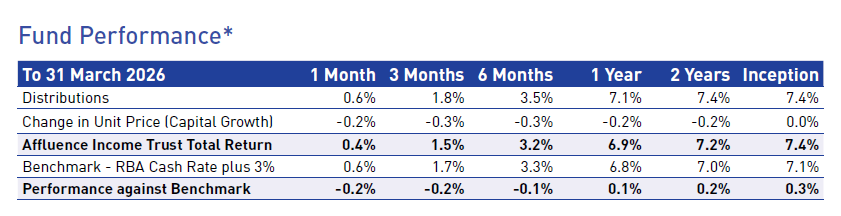
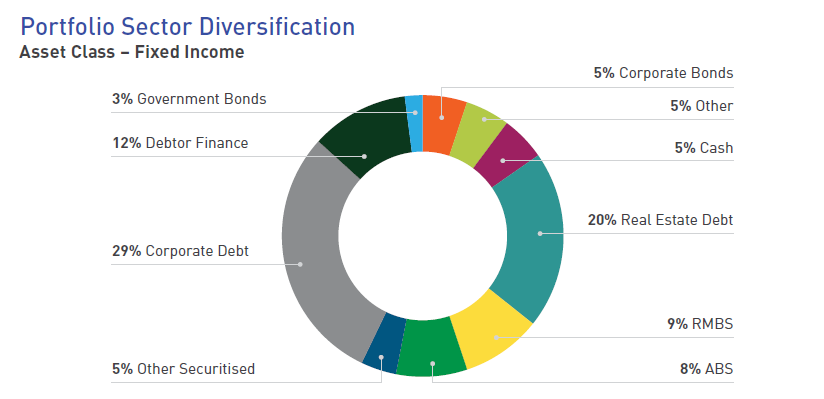
The Affluence Income Trust invests in a highly diversified fixed income portfolio, with a focus on maximising returns with low volatility. The Fund has a flexible investment mandate. This allows us to take advantage of what we believe to be the best risk adjusted investment opportunities within the fixed income asset class at any given time.
We aim for the portfolio to be diversified within the fixed income asset class by sub-sector, underlying manager, investment strategy, credit risk, liquidity, and investment structure.
Things We Found Interesting
Chart of the Month 1
Excluding healthcare, the US economy has shed 373,000 jobs over the last ten months.
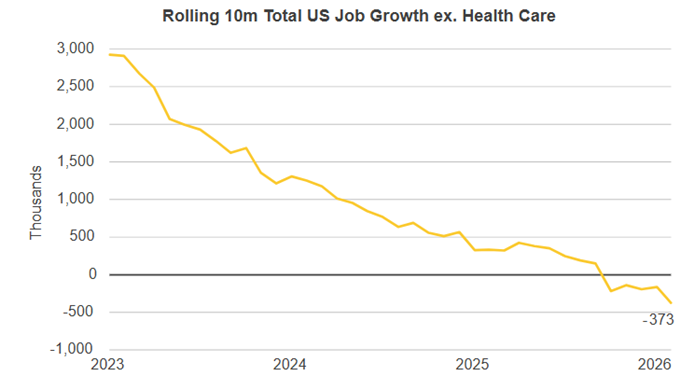
Despite this negative jobs growth, the US economy still grew by 2.5% over the last two quarters of 2025. How can this be? Well, the US has something we in Australia can only dream about. Productivity growth.
Could this be a sign of a slowing economy? Or is it the first wave of AI related job losses? It’s not yet clear, but it is something we’re watching closely.
Chart of the Month 2
Here’s something confusing. If AI is going to destroy jobs, and one of the areas most impacted by AI is software development, why are job ads for software engineers increasing?
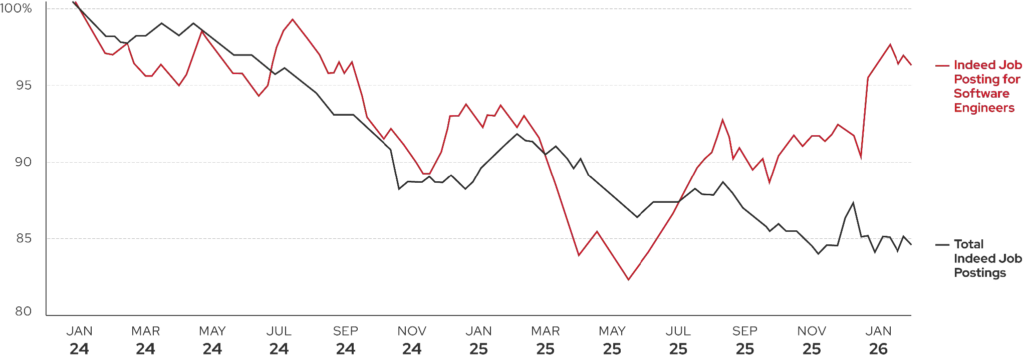
AI will probably be the big story of 2026, even though it’s been overshadowed a little by a war in the last 6 weeks. What’s crucial to figure out is what the rate of change will be. Financial markets can absorb huge changes over a decade or more (like the internet in the early 2000’s). But if things flip overnight, figuring out the AI winners and losers is much harder.
A year ago, software stocks were flying, as perceived beneficiaries of AI. Now they’re all considered losers, and prices have fallen markedly, to the point where valuations for many of them now appear reasonable, and some even cheap. Very few people would have predicted that.
Are you tracking your retirement savings?
ASIC recently commissioned national research which shows that:
- Almost half (48%) of Australians aged 50 to 66 are worried they will run out of money in retirement.
- Around a third (32%) feel they are already behind in preparing for retirement.
- Just 18% have a clear retirement plan in place.
In response, ASIC has added a Retirement Planner to the Moneysmart website. You can:
- See how much income you could have in retirement from super, the Age Pension and other sources.
- Understand whether you may be on track for the retirement you want.
- Explore how different scenarios could affect your income over time.
Vaguely Interesting Facts
Astound your friends with these morsels of knowledge:
- In South Korea, there’s a special emergency number just for reporting spies (dial 113).
- There are more possible games of chess than atoms in the observable universe.
- Greenland is mostly ice, while Iceland is mostly green.
- Tomatoes have more genes than humans do.
- Cheese is the most stolen food in the world. *
* It’s estimated by the Centre for Retail Research that cheese accounts for 3–4% of all retail theft globally. Why cheese? Well, actually a number of reasons. Premium cheeses can be expensive, so it’s worth the trouble. Cheese is small and easy to conceal. There’s a black market for food products in many countries. And unlike other products, like electronics, cheese has no serial number, so it’s hard to trace. In some countries, organised theft rings have targeted entire shipments. The UK has seen multiple large-scale thefts of cheddar and specialty cheeses, often involving organised gangs.
In some cases. Values have reached £20,000–£50,000+ per hit. In 2016, a truck carrying about $70,000 worth of parmesan and other specialty cheeses was stolen in Wisconsin (apparently, it’s America’s cheese heartland). Italy has also had organised crime involvement in cheese theft, particularly Parmigiano Reggiano, which can age for years and be worth hundreds of dollars per wheel. Entire warehouses have been targeted, involving thousands of cheese wheels.
Thanks for reading. If you enjoyed this newsletter, forward it to a friend. If you are that friend, you can subscribe at the bottom of this page.